Views: 0 Author: Site Editor Publish Time: 2019-02-12 Origin: Site


Centrifugal casting is a metal casting process that uses centrifugal force generated by the rotation of a mold to distribute molten metal evenly along the mold wall.
Compared with traditional casting methods, centrifugal casting can produce castings with higher density, better mechanical properties and fewer internal defects. Because of these advantages, this technology is widely used for manufacturing cylindrical and hollow components such as bushings, sleeves, cylinder liners, pipes and bearing rings.
WELTOP Machinery provides professional centrifugal casting machines and customized casting solutions for different materials and production requirements, including bronze, copper alloys, cast iron and steel.
The centrifugal casting process mainly includes mold preparation, mold rotation, metal pouring, solidification and casting removal.
Before casting, the mold surface is cleaned and prepared according to the casting material and production requirements.
For different applications, metal molds with different structures and materials can be designed to achieve stable casting quality and longer service life.
During production, the mold rotates at a controlled speed.
The centrifugal force generated by rotation pushes the molten metal toward the mold wall, forming a dense outer structure while reducing gas pores and impurities inside the casting.
The molten metal is poured into the rotating mold.
Under continuous rotation, the metal gradually solidifies from the outside toward the inside, creating a uniform structure with excellent mechanical properties.
The rotation speed, pouring temperature and cooling conditions are important parameters that affect casting quality.
After solidification, the finished casting is removed from the mold.
For industrial production, hydraulic extraction systems and automated handling systems can be integrated into centrifugal casting equipment to improve efficiency and reduce labor requirements.
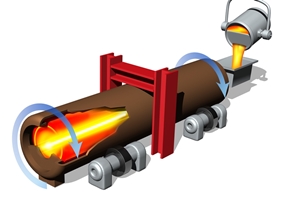
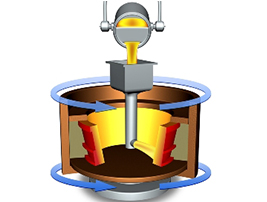
According to casting direction and machine structure, centrifugal casting can mainly be divided into horizontal centrifugal casting and vertical centrifugal casting.
Horizontal centrifugal casting is widely used for producing long cylindrical castings.
Typical applications include:
Bronze bushings
Copper alloy sleeves
Cylinder liners
Steel pipes
Cast iron tubes
Horizontal centrifugal casting machines are suitable for continuous production and high-quality hollow castings.
WELTOP J51 series horizontal cantilever centrifugal casting machines are designed for industrial production of sleeves, bushings and cylinder liners with stable operation and high casting accuracy.
Vertical centrifugal casting is mainly used for shorter cylindrical parts, rings, discs and components requiring precise dimensions.
Typical applications include:
Bearing rings
Flanges
Wear-resistant rings
Special alloy castings
Vertical centrifugal casting machines provide good control for small height and large diameter castings.
Centrifugal casting offers several advantages compared with conventional casting processes.
The centrifugal force helps remove gas and impurities from the molten metal, resulting in a dense casting structure and improved mechanical performance.
Because the casting material is concentrated where it is needed, centrifugal casting can reduce machining allowance and improve material utilization.
For components such as bronze bushings, cylinder liners and bearing sleeves, centrifugal casting provides excellent wear resistance and longer service life.
Centrifugal casting machines can be used for different metals and alloys, including:
Bronze
Brass
Copper alloys
Cast iron
Stainless steel
Alloy steel
Centrifugal casting technology is widely used in many industrial fields.
Bronze bushings and copper alloy sleeves require high wear resistance and dimensional accuracy.
Centrifugal casting helps achieve a compact structure and stable performance for heavy-duty applications.
Cylinder liners produced by centrifugal casting are widely used in engines and industrial equipment.
The process provides excellent wear resistance and uniform wall thickness.
Centrifugal casting is also suitable for producing:
Steel pipes
Stainless steel tubes
Cast iron pipes
Large hollow cylinders
Choosing a suitable centrifugal casting machine depends on several factors:
Casting material
Outer diameter and inner diameter
Casting length
Production capacity
Required accuracy
Automation level
For small and medium-sized sleeve production, a horizontal cantilever centrifugal casting machine is usually an efficient solution.
For high-volume production, automated centrifugal casting lines can provide higher productivity through automatic pouring, mold changing and casting handling systems.
WELTOP Machinery specializes in the design and manufacture of centrifugal casting equipment for global foundry customers.
Our product range includes:
Horizontal cantilever centrifugal casting machines
Automated centrifugal casting production lines
Vertical centrifugal casting machines
Centrifugal casting molds and auxiliary equipment
With professional engineering experience and customized solutions, WELTOP supports customers in producing high-quality sleeves, bushings, cylinder liners and various hollow castings.
Contact WELTOP Machinery for a customized centrifugal casting solution according to your casting requirements.